
IRS Form 8938 - Reporting Requirement For Individuals With Foreign Assets
Caution
This requirement is in addition to the FBAR requirement discussed elsewhere in this chapter. Certain foreign financial accounts are reported on both Form 8938 and the FBAR. However, the information required by the forms is not identical in all cases. Different rules, key definitions (for example, “financial account”), and reporting requirements apply to Form 8938 and FBAR reporting. Because of these differences, certain foreign financial accounts may be reportable on one but not both forms.
It is important to note that Americans who hold foreign assets are still required to file FINCEN Form 114 regardless of if they are required to file Form 8938. There may be some overlap between the types of accounts reported on the two forms but this is not true in all cases.
In regard to Form 8938 specifically, any individual who, during the tax year, holds any interest in a “specified foreign financial asset” must attach to his or her income tax return for that tax year the information described below in “Required Information” for each specified foreign financial asset if the aggregate value of all the individual's specified foreign financial assets exceeds $50,000 or a dollar amount higher than $50,000 as IRS may prescribe. (Code Sec. 6038D(a)) Temporary and final regulations (TD 9706, 12/11/14; Reg. Sections 1.6038D-0 through 1.6038D-8) provide for varying thresholds, some of which are more than $50,000, depending on marital status and whether the individual resides in the U.S. or abroad. (Reg. § 1.6038D-2)
The Code Sec. 6038D reporting requirement also applies to any domestic entity formed or availed of for purposes of holding, directly or indirectly, specified foreign financial assets, in the same manner as if the entity were an individual. (Code Sec. 6038D(f)) For additional details related to these entities, see proposed regulations NPRM REG-130302-10 and final regulations, TD 9706.
Filing Exception
An individual is not required to file a foreign financial assets report for a tax year in which he or she is not required to file an income tax return, even if the value of the individual’s specified foreign financial assets for that year exceeds the filing threshold amount. (Reg. § 1.6038D-2(a)(7)) Caution: this filing exception does not apply for FBARs, so even if an individual is not required to file an income tax return, an FBAR still must be filed if the value of the individual’s foreign financial accounts exceeds the $10,000 threshold.
Reporting Thresholds
Reporting (on Form 8938) is required if the total value of specified foreign financial assets is greater than the amounts shown in the following table, either as of the end of the tax year or at any time during the tax year, based on marital status and residency in the U.S. or abroad.
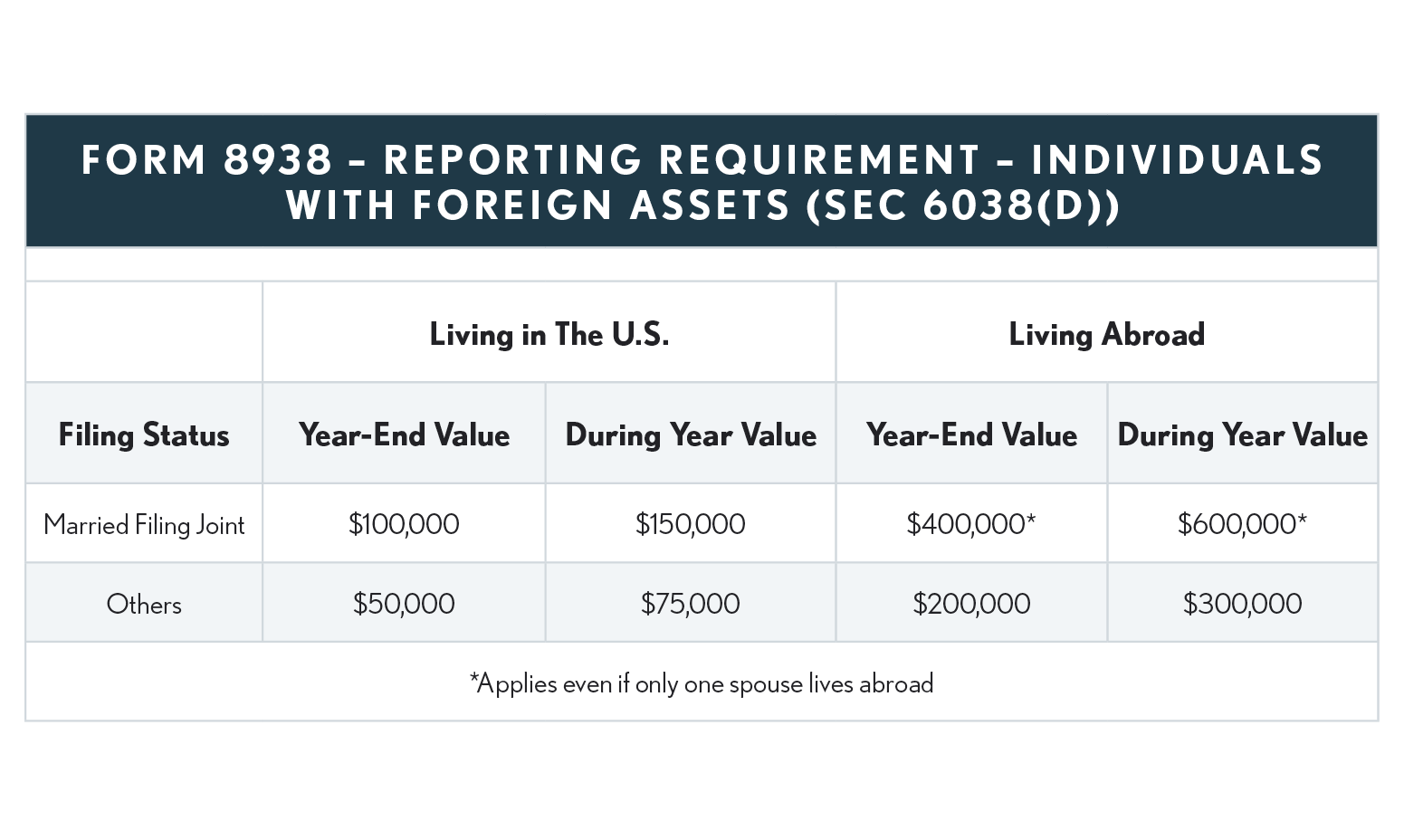
The presence abroad test is satisfied if a U.S. citizen has been a bona fide resident of a foreign country or countries for an uninterrupted period that includes an entire tax year, or if a U.S. citizen or resident was present in a foreign country or countries at least 330 full days during any period of 12 consecutive months that ends in the tax year being reported. (Form 8938 Instructions)
Specified Foreign Financial Asset
For purposes of the reporting requirement for individuals with foreign assets, a “specified foreign financial asset” (Code Sec. 6038D(b)) is:
-
Any “financial account” maintained by a “foreign financial institution”, and
-
Any of the following assets which are held for investment and are not held in an account maintained by a “financial institution”:
-
Any stock or security issued by a person other than a U.S. person (Code Sec. 6038D(b)(2)(A))
-
Any financial instrument or contract held for investment that has an issuer or counterparty that is other than a U.S. person (Code Sec. 6038D(b)(2)(B)), and
-
Any interest in a “foreign entity” (as defined in Code Sec. 1473).Examples of non-financial account assets that may be considered other specified foreign financial assets include: Stock issued by a foreign corporation; a capital or profits interest in a foreign partnership; a note, bond, debenture, or other form of indebtedness issued by a foreign person; an interest in a foreign trust; an interest rate swap, currency swap, basis swap, interest rate cap, interest rate floor, commodity swap, equity swap, equity index swap, credit default swap, or similar agreement with a foreign counterparty; and any option or other derivative instrument with respect to any of the items listed as examples in this paragraph or with respect to any currency or commodity that is entered into with a foreign counterparty or issuer (Reg. § 1.6038D-3(d)).
-
An interest in a foreign social security, foreign social insurance or other similar program of a foreign government is not a specified foreign financial asset.
Financial Account (Code Sec. 1471(d)(2)) - Except as otherwise provided by the Secretary, the term
“Financial account” means, with respect to any financial institution—
-
any depository account maintained by such financial institution
-
any custodial account maintained by such financial institution, and
-
any equity or debt interest in such financial institution (other than interests which are regularly traded on an established securities market).
Foreign Financial Institution (Code Sec. 1471(d)(4)) - The term “foreign financial institution” means any financial institution which is a foreign entity. Except as otherwise provided by the Secretary, such term shall not include a financial institution which is organized under the laws of any possession of the United States. A foreign financial institution includes investment vehicles such as foreign mutual funds, foreign private equity funds and foreign hedge funds.
Financial Institution (Code Sec. 1471(d)(5)) - Except as otherwise provided by the Secretary, the term “Financial institution” means any entity that—
-
accepts deposits in the ordinary course of a banking or similar business
-
as a substantial portion of its business, holds financial assets for the account of others, or
-
is engaged (or holding itself out as being engaged) primarily in the business of investing, reinvesting, or trading in securities, partnership interests, commodities, or any interest including a futures or forward contract or option in such securities, partnership interests, or commodities.
Required Information
With respect to any specified foreign financial asset, in addition to the maximum value of the asset during the year, the following information must be provided:
-
For accounts: The name and address of the financial institution in which the account is maintained, and the account number.
-
For stock or securities: The name and address of the issuer and enough information as is necessary to identify the class or issue of which the stock or security is a part.
-
For any other instrument, contract or interest: Such information as is necessary to identify the asset, and the names and addresses of all issuers and counterparties with respect to the asset. This information will be reported on IRS Form 8938, Statement of Specified Foreign Financial Assets. In addition to the information listed above, if a foreign currency exchange rate was used to convert the value of the foreign asset to U.S. dollars, the rate and source of the exchange rate must be disclosed. In most cases, the U.S. Treasury Bureau of the Fiscal Service foreign currency exchange rate for purchasing U.S. dollars must be used. This rate can be found on the following government web site (Form 8938 instructions):
One section of the 8938 requires a recap by type of income from the foreign asset(s) that is reported on the return and a description of the form or schedule and line number where it is reported. Refer to the instructions for the 8938 regarding valuing the assets and other useful information.
Failure to Timely Disclose Information
If any individual fails to furnish the information related to foreign assets as described in Code Sec. 6038D(c) for any tax year at the time and in the manner described, he or she must pay a penalty of $10,000 (not subject to inflation adjustment). If this failure continues for more than 90 days after the day on which IRS mails notice of the failure to the individual, the individual will be penalized (in addition to the penalties imposed under Code Sec. 6038D(d)(1), discussed above) $10,000 for each 30-day period (or fraction of the 30-day period) during which the failure continues after the expiration of the 90-day period. The penalty imposed for any failure can't exceed $50,000.
Example - An individual who is notified of his failure to disclose for a single tax year, and who takes remedial action on the 95th day after the notice is mailed, incurs a penalty of $20,000 comprised of the base amount of $10,000, plus $10,000 for the fraction (i.e., the five days) of a 30-day period following the lapse of 90 days after the notice of noncompliance was mailed.
-
To the extent IRS determines that the individual has an interest in one or more foreign financial assets but he or she doesn't provide enough information to enable IRS to determine the aggregate value of those assets, the aggregate value of those assets will be presumed to have exceeded $50,000 (or other applicable reporting threshold amount) for purposes of assessing the penalty. (Joint Comm Staff, Tech Expln (JCX-410), 2/23/2010, p. 61)
No penalty will be imposed by Code Sec. 6038D on any failure that is shown to be due to reasonable cause and not due to willful neglect. The fact that a foreign jurisdiction would impose a civil or criminal penalty on the taxpayer (or any other person) for disclosing the required information isn't reasonable cause. (Code Sec. 6038D(g))
Accuracy-Related Penalty for Certain Undisclosed Foreign Assets
A 40% accuracy-related penalty is imposed for underpayment of tax that is attributable to an undisclosed foreign financial asset understatement (IRC Sec. 6662(b)(7) and (j)). This is double the normal accuracy-related penalty rate.
Statute of Limitations Extensions
If Form 8938 is not filed when it is required, or the taxpayer fails to report a required specified foreign financial asset, the statute of limitations for the tax year may remain open for all or a part of the return until 3 years after the date on which the Form 8938 is filed.
In addition, if the taxpayer omits more than $5,000 from gross income attributable to a specified foreign financial asset, the statute of limitations is extended to six years after the return is filed. (IRC Sec. 6501(e)(1)(A))