
Cryptocurrency Primer
This is a primer on how cryptocurrencies (virtual currencies) function, along with information on IRS’s guidance included in Notice 2014-21 for dealing with taxable transactions involving virtual currency. Virtual currency that has an equivalent value in real currency, or that acts as a substitute for real currency, is referred to as “convertible” virtual currency. Bitcoin is one example of a convertible virtual currency. Bitcoin can be digitally traded between users and can be purchased for, or exchanged into, U.S. dollars, Euros, and other real or virtual currencies.
“Virtual currency” may be used to pay for goods or services or held for investment. Virtual currency is a digital representation of value that functions as a medium of exchange, a unit of account, and/or a store of value. In certain contexts, virtual currency may serve one or more of the functions of “real” currency -- i.e., the coin and paper money of the United States or of any other country that is designated as legal tender, circulates, and is customarily used and accepted as a medium of exchange in the country of issuance -- but the use of virtual currency to perform “real” currency functions is limited.
Bitcoin, first released as open-source software in 2009, is generally considered the first decentralized cryptocurrency. Since the release of Bitcoin, over 5,000 altcoins (alternative variants of Bitcoin, or other cryptocurrencies) have been created – the exact number varies by source and keeps going up.
For a more detailed (and complex) understanding of cryptocurrencies, research the Internet.
Owner Demographics
In the early days of cryptocurrency, the individuals most likely to deal in virtual currency were generally tech savvy, might also have had an inherent distrust of the government and liked the lack of government regulations controlling and tracing virtual currency transactions. As time has passed, cryptocurrency has begun to appeal to a wider range of users and investors, and tax preparers are now more likely to have clients investing in virtual currencies. Not unexpectedly, the federal government has begun issuing notices and regulations, and cracking down on taxpayers who fail to report taxable crypto transactions.
Market Value Determination
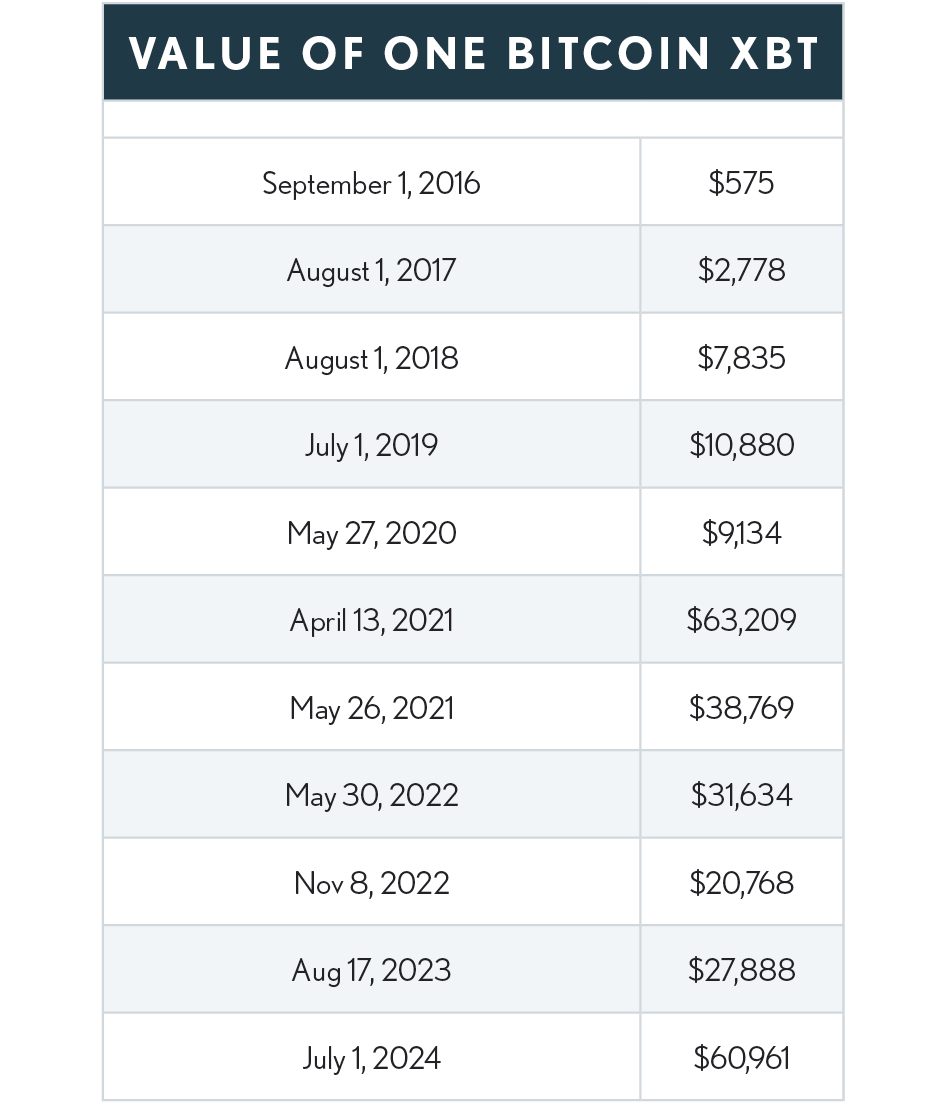
The FMV of virtual currency is based on market value, i.e., what a willing buyer will pay a willing seller – much like trading in stocks. That is why the IRS made the decision to treat virtual currency transactions as property transactions. The FMV of virtual currency is extremely volatile, as can be seen in the adjacent table for Bitcoin.
Treated as Property for Federal Tax Purposes
Although virtual currency may seem like money, according to the IRS it is treated as property. General tax principles applicable to property transactions apply to transactions using virtual currency (IRS Notice 2014-21, Q&A #1).
Example A- Taxpayer buys Bitcoin (BTC) so he can use it to make on-line purchases without the need for a credit card. He buys one BTC for $2,425 and later uses it to buy goods worth $500 (BTC was trading at $2,500 at the time he made his purchase). He has a $75 ($2,500 - $2,425) reportable capital gain. This is the same result that would have occurred if he had sold the BTC at the time of the purchase and used cash to purchase the goods. This example points up the complicated record-keeping requirement to track BTC basis. Since this transaction was personal in nature no loss would be allowed if the value of BTC had been less than $2,425 at the time the goods were purchased. Of course, if the taxpayer in this example only sold a fraction of a Bitcoin, enough to cover the $500 purchase, the gain would only be $15: $500/$2500 = .2 x 2425 = 485; 500 – 485=15
-
So, while it is necessary to report the disposition of virtual currency when it is sold for cash, used to buy something, or traded for another cryptocurrency, just transferring the currency from an on-line wallet to an exchange, or vice versa, is not a disposition.
Character of the Gain or Loss
The character of the gain or loss generally depends on whether the virtual currency is a capital asset in the hands of the taxpayer. A taxpayer generally realizes capital gain or loss on the sale or exchange of virtual currency that is held as a capital asset. For example, stocks, bonds, and other investment property are generally capital assets. A taxpayer generally realizes ordinary gain or loss on the sale or exchange of virtual currency that he or she does not hold as a capital asset. Inventory and other property held mainly for sale to customers in a trade or business are examples of property that is not a capital asset.
Wash Sale Rules
The IRS treats crypto as property, not as a security (like a stock or bond); thus, it escapes wash sale rules under present law. CAUTION: A provision that would subject cryptocurrency transactions to the wash sale rules was included in the failed 2021 Build Back Better Act. It’s likely the provision will resurface in future legislation.
Sec 1031 Exchanges
After 2017, TCJA only allows Sec 1031 tax deferral for domestic real estate exchanges. Thus Sec 1031 cannot be used for virtual currency exchanges.
Foreign Currency Transactions
Under currently applicable law, virtual currency is not treated as currency that could generate foreign currency gain or loss for U.S. federal tax purposes (IRS Notice 2014-21, Q&A #2). Although Notice 2023-34 modified Notice 2014-21 to remove language stating that virtual currency does not have legal tender status in any jurisdiction, the IRS did not change its position that convertible virtual currency is not treated as currency that could generate foreign currency gain or loss for federal tax purposes.
Virtual Currency FBAR and Form 8938 Filings
-
FBAR - According to current FinCEN directives (FinCEN Notice 2020-2 and FIN-2013-G001), generally US taxpayers at this time are only required to disclose cryptocurrency information on an FBAR in 2024 if crypto is maintained within an overseas account that also contains assets subject to reporting. Those who have virtual currency in foreign accounts and use it to purchase goods or services on their own behalf are not required to file an FBAR. This contrasts with a money services business administrator or exchanger under FinCEN’s regulations (specifically, a money transmitter) who is generally subject to the FBAR rules. However, FinCEN has said that it intends to propose to amend the regulations implementing the Bank Secrecy Act regarding FBARs to include virtual currency as a type of reportable account. (FinCEN Notice 2020-2, Jan. 4, 2021) SO STAY ALERT!
-
8938 - Statement of Specified Foreign Financial Assets – Cryptocurrency held in foreign cryptocurrency exchanges requires reporting on Form 8938 (assuming the taxpayer meets the Form 8938 filing threshold).
Payment for Goods & Services
A taxpayer who receives virtual currency as payment for goods or services must, in computing gross income, include the fair market value of the virtual currency, measured in U.S. dollars, as of the date that the virtual currency was received (IRS Notice 2014-21, Q&A #3).
Get Around Money Reporting Laws
There is no bank to report transfers to the government.
How Does One Acquire Bitcoins
One can go to online exchanges and purchase Bitcoins. But care should be taken to make sure the exchange is reputable. There are even Bitcoin ATMs (kiosks) where cash can be exchanged for Bitcoins. Then you have Bitcoins in your on-line wallet and are free to spend them with anyone that accepts Bitcoins.
Bitcoin Mining
Mining is a term used to describe how cryptographic information distributed within a Bitcoin network is secured, authorized, and approved. In essence it is the processing of payments that have taken place once they occur. It takes the place of banks, merchant’s accounts, and clearing houses like Visa. It essentially eliminates all the third parties’ cuts of income from the transaction. It involves complex mathematical logarithms that need to be solved and the mining process, which requires high-powered computers, completes this task autonomously.
According to the Bitcoin source code, only 21 million bitcoins may be mined, and according to various internet sources, about 19.7 million have been produced as of June 2024.
What do miners get for dedicating computer hardware and for the cost of electricity to handle the transactions? After adding a block to the ledger, the miner is given a reward for their efforts, which varies based on the cryptocurrency. For example, Bitcoin originally awarded 50 BTCs, but as of April 19, 2024 Bitcoin miners are rewarded with 3.125 bitcoins, and the reward will be halved again in April 2028.
If an individual mines virtual currency, it is a trade or business subject to self-employment tax (Notice 2014-21, Q&A #9). The income is the value of the generated income equal to the value of the Bitcoin when mined. Although the IRS has provided no guidance at this time, the expenses of producing the mined Bitcoins would have to be capitalized. Several internet sources indicated that there are approximately 1 million Bitcoin miners, nearly three times as many as there were in 2019, although estimating how many miners there are is a challenge. Thus, the odds of doing a miner’s tax return are increasing.
Apparently, Bitcoin miners are subject to Form 1099-K filing requirements if certain requirements are met. In general, a third party that contracts with a substantial number of unrelated merchants to settle payments between the merchants and their customers is a third-party settlement organization (TPSO). A TPSO is required to report payments made to a merchant on a Form 1099-K, Payment Card and Third-Party Network Transactions, if the reporting threshold is met.
Note:
The new $600 threshold for 1099-K was supposed to have been effective for 2023 but instead is being phased in.
The threshold for calendar year 2023 and prior calendar years is a 2-part test: both (1) the number of transactions settled for the merchant had to exceed 200, and (2) the gross amount of payments made to the merchant exceeded $20,000.
New 1099-K Reporting Threshold
Effective for 1099-Ks required to be filed for calendar years that begin after December 31, 2023 the IRS is planning a $5,000 reporting threshold. (ARPA Sec 9674, amending IRC Sec 6050W(e))
Employee Payments
The fair market value of virtual currency paid as wages is subject to federal income tax withholding, Federal Insurance Contributions Act (FICA) tax (Social Security and Medicare A), and Federal Unemployment Tax Act (FUTA) tax and must be reported on Form W-2, Wage and Tax Statement. (IRS Notice 201421, Q&A #11) Of course, these amounts are to be reported in U.S. dollars.
Independent Contractor Payments
The fair market value of virtual currency received for services performed as an independent contractor, measured in U.S. dollars as of the date of receipt, constitutes self-employment income and is subject to the self-employment tax (IRS Q&A #10). Payment may also be subject to informational reporting (IRS Notice 2014-21, Q&A #13).
Virtual Currency Payments for Crowdfunding Microtasks
A taxpayer who receives convertible virtual currency in exchange for performing a microtask (a small, simple task) through a crowdsourcing or similar platform has received consideration in exchange for performing a service, and the convertible virtual currency received is taxable as ordinary income. (Chief Counsel Advice 202035011)
Informational Reporting
A payment made using virtual currency is subject to information reporting to the same extent as any other payment made in property. For example, a person who during a trade or business makes a payment of fixed and determinable income using virtual currency with a value of $600 or more to a U.S. non-exempt recipient in a taxable year is required to report the payment to the IRS and to the payee (IRS Notice 2014-21, Q&A #12).
Backup Withholding
Payments made using virtual currency are subject to backup withholding to the same extent as other payments made in property. Therefore, payers making reportable payments using virtual currency must solicit a taxpayer identification number (TIN) from the payee. The payer must backup withhold from the payment if a TIN is not obtained prior to payment or if the payer receives notification from the IRS that backup withholding is required (IRS Notice 2014-21, Q&A #14).
Hard Forks and Airdrops
In Rev Rul 2019-24 (October 2019) the IRS released cryptocurrency guidance on virtual currency that explains that a taxpayer:
-
Does not have gross income from a hard fork* of the taxpayer's cryptocurrency if the taxpayer does not receive units of a new cryptocurrency; and,
-
Has ordinary income because of an airdrop** of a new cryptocurrency following a hard fork if the taxpayer receives units of the new cryptocurrency.
* A hard fork occurs when a cryptocurrency undergoes a protocol change resulting in a permanent diversion from the legacy distributed ledger. This may result in the creation of a new cryptocurrency on a new distributed ledger in addition to the legacy cryptocurrency on the legacy distributed ledger. (IRS website FAQ #22)
** An airdrop is a distribution of cryptocurrency to multiple taxpayers’ distributed ledger addresses.
Bitcoin underwent a hard fork on August 1, 2017, which resulted in the creation of a new cryptocurrency, Bitcoin Cash. According to an IRS Chief Counsel Advice Memorandum, taxpayers who received Bitcoin Cash because of the 8/1/2017 Bitcoin hard fork received ordinary income because the taxpayers had an accession to wealth under IRC Sec. 61. Further, the date of receipt and fair market value to be included in income was dependent on when the taxpayer obtained dominion and control over the Bitcoin Cash. (CCA 202114020)
See additional IRS FAQs for the tax treatment of cryptocurrency.
Practice Tip
Even though the IRS has created a procedure for tracking changes to FAQs published on its website (see the guide "Tax Potpourri), if you are using the answer to an FAQ for a particular situation, you should consider printing a copy of the relevant FAQ and keeping it in your file. Also remember that FAQs generally aren’t considered as substantial authority for a tax position (even though sometimes they are the only clue from the IRS as to the Service’s position on the matter).