
Guidelines for IRS Financial Analysis of a Taxpayer’s Offer
As outlined in the Internal Revenue Manual 5.8: In processing an OIC, the IRS will perform a detailed analysis of the submitting taxpayer’s financial condition. The taxpayer submits financial information on Form 433-A, Collection Information Statement for Wage-earners and Self-employed Individuals, or Form 433-B, Collection Information Statement for Businesses.
The IRS primarily uses National and Local Standards as their guideline in determining the necessary expense levels to be allowed in finalizing an offer. The standard amounts are designed to account for the basic living expenses of the taxpayer according to income level. Sometimes, based on a taxpayer’s circumstances or possible economic hardship, the Service may diverge from the standard amounts in determining basic expense levels. A taxpayer must provide reasonable substantiation of all expenses that exceed the standard amounts, including bank statements, cancelled checks, credit card receipts, rent/lease receipts and agreements, payment coupons, court orders, contracts, future events that may increase expenses (e.g., birth of a child).
Auditors are instructed that analysis and verification of the Forms 433-A or -B should take place shortly after the forms are received. The ability to pay determination based on the analysis should be given to the taxpayer within “a reasonable amount time.” The forms the taxpayer submits should reflect data no older than the prior 6 months. If, during the IRS investigation time, the data becomes older than 12 months, the personnel working the case will ask for updated information. At times, they may even request a new Form 433.
A face-to-face conference with the taxpayer (and/or his/her representative) is the IRS preferred method for reviewing the Form 433 information. Telephone and mail contact may be used to secure some information.
The expectation of the IRS in coming to an agreeable compromise amount is this: The taxpayer is expected to be able to pay a tax liability equal to that over and above necessary (or not allowable conditional) expenses.
IRS Analysis of a Taxpayer’s Financial Information
The goal of the IRS analysis is, of course, to determine the amount of disposable income (gross income less all allowable expenses) available to apply to the tax liability.
Allowable expenses include those expenses that meet a necessary expense test. This necessary expense test defines expenses that are essential to provide for a taxpayer’s and his/her family’s health and welfare and/or for production of income. The expenses must be reasonable. The total of the necessary expenses will establish the minimum a taxpayer and family need to live.
The guidelines use 3 standards for determining necessary expense based on a taxpayer’s income level:
-
National standards
-
Local standards
-
Other
See the IRS web site for links to the most current standards: https://www.irs.gov/businesses/small-businesses self-employed/collection-financial-standards
National Standards
These expense standards come from the Bureau of Labor Statistics Consumer Expenditure Survey. They establish standards for what are considered reasonable amounts for five types of expenses. The expenses include:
-
Food (all meals, home and away)
-
Housekeeping Supplies (including laundry and cleaning supplies, other household products, paper products, lawn and garden supplies, postage, stationary, and miscellaneous supplies)
-
Apparel and Services (including shoes, clothing, laundry, dry cleaning, shoe repair)
-
Personal Care Products And Services (including hair care costs, barber and beautician services, oral hygiene products, shaving needs, cosmetics, perfume bath preparations, deodorants, feminine hygiene products, electric personal care appliances, personal care services, and repair of personal care appliance)
-
Miscellaneous (a discretionary amount established by the IRS rather than Labor Statistics).
Local Standards
Local standards apply to 2 types of expenses:
-
Housing (all utilities [including gas, electricity, water, fuel, oil, other fuels, trash collection, telephone, cell phone, cable television and internet services], mortgage/rent, property taxes, interest, parking, maintenance, home insurance, homeowner dues)
-
Transportation (vehicle insurance, vehicle payments and repairs, fuel, vehicle registration, parking, tolls, driver’s license, public transportation). Transportation costs not required to produce income or ensure health of taxpayer and family aren’t considered necessary.
Taxpayers are allowed the lesser of: the local standard or the amount actually paid by the taxpayer. Note: The IRS has established a housing cost level for each county in the U.S.
Other
Other expenses than those cited under National and Local Standards may be allowed if they meet the necessary expense test. Such expenses must provide for the health and welfare of the taxpayer and family or be for the production of income and are based on the discretion of the IRS.
Conditional Expenses
These expenses don’t meet the necessary expense test. However, they may be allowable as necessary if the tax liability, including projected accruals, can be fully paid within 5 years. In addition, under a 1year rule, a taxpayer has up to one year to modify or eliminate excessive necessary or not allowable conditional expenses if the tax liability, including projected accruals, cannot be fully paid within 5 years.
Note: National and local expense standards are guidelines. If it is determined a standard amount is inadequate to provide a specific taxpayer’s basic living expenses, the IRS is instructed to allow divergence from the standards.
Example - Applying National Standards for Expenses: Charlie and Marie had the following monthly expenses: housekeeping supplies, $150; clothing $160; food, $600, miscellaneous, $400. In all, their total monthly expenses were $1,310. Let’s say that the Bureau of Labor Statistics National Standard for these expenses is $1,292. The taxpayers would be allowed $1,292 as their necessary expense amount unless they could substantiate and justify to the IRS’s satisfaction the need for the additional amount.
-
Worksheet
The worksheet included in the 656-B (booklet) can be completed using data from Form 433-A. It is useful in determining how much a taxpayer’s Form 656 compromise offer should be.
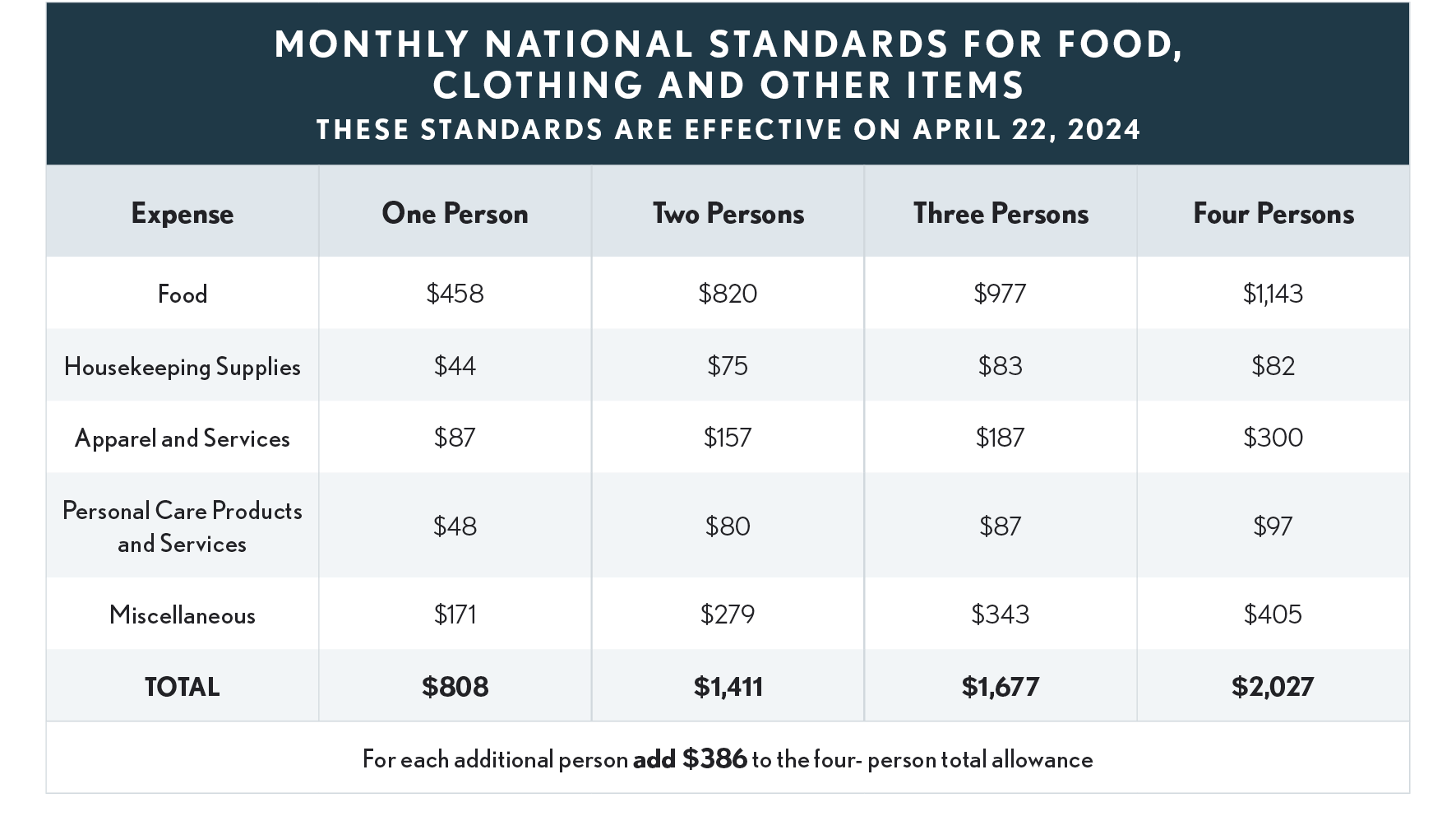
With inflation fluctuation a common occurrence, be sure to check for updated standards at: